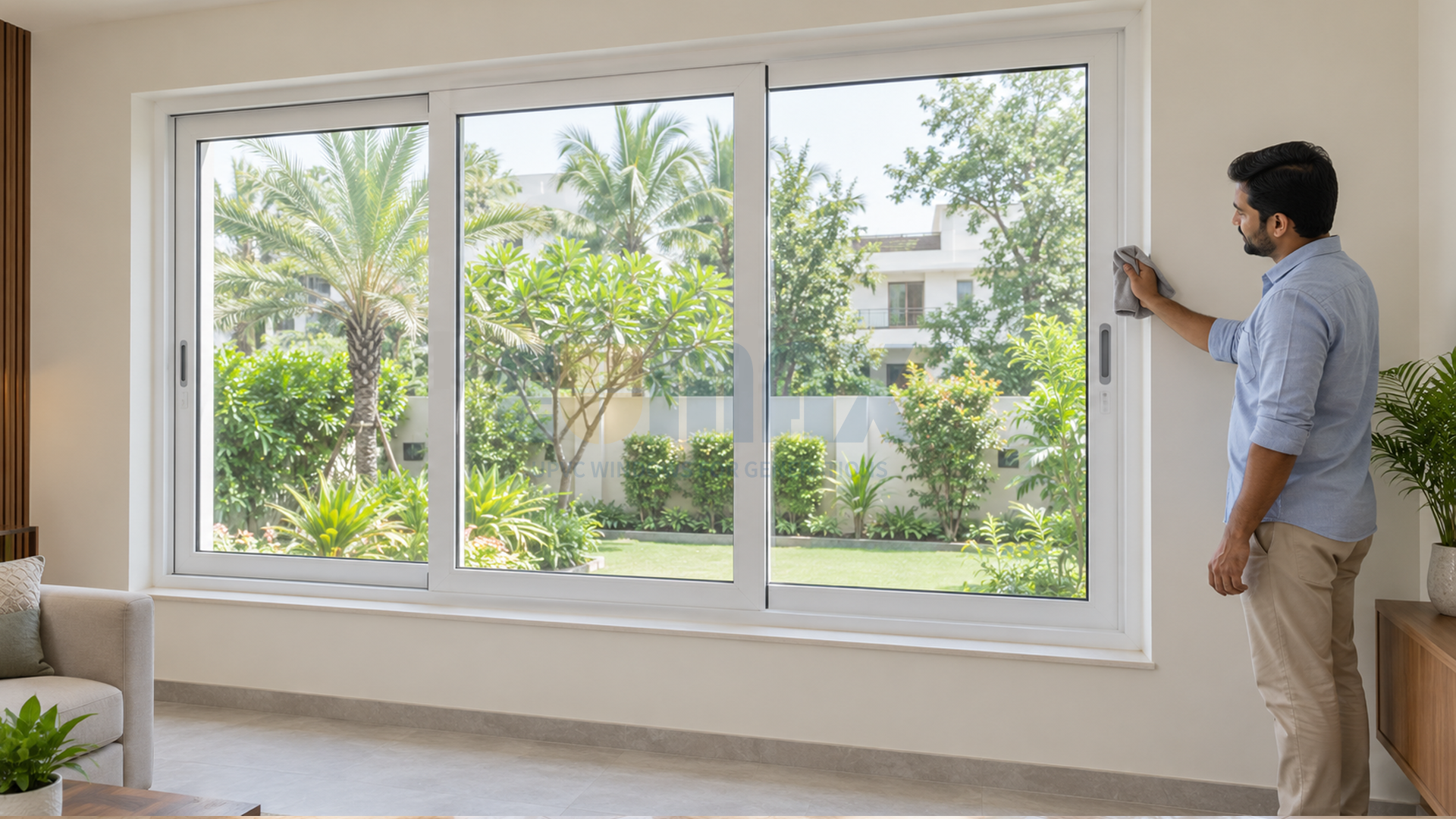
A window is not a product you buy. It is a product you buy and then someone fits into a hole in your wall, and the second half determines most of what you experience afterwards.
This is the part of the process buyers scrutinise least. Profile series get compared, glass gets debated, hardware brands get checked. Then the installation is left to whoever the supplier sends, on a day nobody supervises.
The best profile in the country will leak if it is fitted out of square. Here is what actually happens during a correct installation, and what to watch for.
Why installation decides performance
Everything a uPVC window does well depends on the frame being square, level, plumb and fully sealed to the surrounding masonry.
Thermal performance depends on there being no air path around the frame. Acoustic performance depends on the same thing — sound travels through a 3mm gap far more readily than through the glass. Weather resistance depends on the seal between frame and wall, and on the drainage channels sitting at the correct angle to shed water outward rather than holding it.
None of that is a property of the window. All of it is a property of the fit.
A frame installed 4mm out of square will still open and close on the day it is handed over. The sash will bind eighteen months later, after the first full cycle of monsoon and summer has worked on the geometry. By then the connection between the problem and its cause is no longer obvious.
What a correct installation involves
Site measurement before fabrication
uPVC windows are cut and welded to your opening dimensions. Unlike aluminium or timber, a finished uPVC frame cannot be trimmed on site — the corners are fusion welded and the reinforcement runs the full length of the section. If the measurement is wrong, the window is wrong.
Measurement should be done by the supplier or fabricator, not passed on from a builder's drawing. Openings are rarely as built as they are as drawn, and a masonry opening is seldom perfectly square. A proper measurement records the width and height at multiple points and works from the smallest.
If a supplier quotes without visiting the site, treat the figure as indicative only.
Removing the old frame
On a replacement job, how the old frame comes out matters. Aggressive removal damages the surrounding masonry and reveal, which then has to be made good — and a poorly repaired reveal gives the new frame nothing solid to fix into.
Old frames should be cut out rather than levered out wherever the surrounding finish is being retained.
Setting and packing the frame
The frame is placed into the opening and shimmed with packers until it is level, plumb and square. This is the step that separates a good installation from a poor one, and it is the step most often rushed.
Packers go at fixing points and at load-bearing positions under the sill, not wherever a gap happens to be. A frame packed only at the corners will bow in the middle once the glass weight goes in.
The installer should be checking with a spirit level and measuring the diagonals — if the two diagonal measurements match, the frame is square. It takes a minute and it is the single most useful check you can watch for.
Mechanical fixing
Frames are fixed into the masonry with screws through the frame section, at spacings the profile system specifies. Foam alone is not a fixing. It is an insulating and sealing material, and a frame held in by foam will move.
Fixings should pass through the reinforced chamber, not just the outer wall of the profile.
Sealing and insulating the perimeter
The gap between the frame and the masonry is filled with low-expansion polyurethane foam. High-expansion foam is the wrong product here — it can exert enough pressure to bow the frame inward as it cures, which is a difficult fault to diagnose and an expensive one to fix.
Once cured, the foam is trimmed back and the joint is sealed externally with a weatherproof sealant. The external seal is what keeps water out; the foam is what stops heat and sound moving through the gap. Both are needed.
Glazing and final adjustment
Glass is set on packers inside the sash so that its weight transfers to the frame at the correct points rather than hanging on the beading. Incorrectly packed glazing is a common cause of sashes dropping out of alignment.
Hardware is then adjusted — hinges, keeps and rollers all have adjustment built in — so that the sash closes with even gasket compression all the way round. This is a fine adjustment, not a one-time setting, and it should be done after the glass is in and the frame has settled.
Making good
Plaster and paint around the frame is usually a separate trade and frequently a separate line on the quote. Confirm before you sign whether it is included, because a gap between "window installed" and "opening finished" is a common source of dispute.
What poor installation looks like later
These are the symptoms that trace back to fitting rather than to the window:
- Draughts around the frame rather than through the sash — the perimeter seal has failed or was never properly formed.
- Water ingress in heavy rain, particularly wind-driven rain. Usually a drainage channel that has been blocked or a frame set at the wrong angle.
- A sash that binds or drags after a year or two — the frame was not square, or the packing was inadequate.
- Uneven gaps between sash and frame when closed. Visible at a glance; means gasket compression is uneven, so the seal is only working on part of the perimeter.
- Cracked plaster radiating from the frame corners — the frame is transferring load it should not be carrying.
Very little on that list is a manufacturing fault, which is why installation warranties and product warranties are separate things and why it matters that both are covered.
Why fabrication quality feeds into this
Installation and fabrication are different jobs, but a badly fabricated window makes a good installation impossible.
If the corners are not welded cleanly and squarely, if reinforcement is missing from the sash, if the drainage slots are cut in the wrong place — no amount of care on site will produce a window that performs. The installer inherits whatever came off the fabrication bench.
This is where Eumax's position differs from most of the Bengaluru market. The company manufactures its own profiles at Nelamangala and runs a fabrication training centre that certifies its channel partners directly. Windows supplied through that network are fabricated to a defined process rather than to whatever practice a given workshop has settled into.
For a buyer, the practical value is a single accountability chain. When the profile, the fabrication standard and the installation training all sit with one company, a defect does not become a negotiation between three parties about whose fault it is.
What to ask before installation day
- Who is doing the installation — the supplier's own team, or a subcontractor?
- Has the opening been measured on site, and by whom?
- Is mechanical fixing included, or is the frame being foamed in only?
- Is external sealant applied as a separate step from the foam?
- Is making good — plaster and paint around the frame — included in the quote?
- Who removes and disposes of the old frames?
- What does the installation warranty cover, and for how long?
- How long will each window take, and how many days will the work run?
On the day
You do not need to supervise a professional team, but a few things are worth noticing.
Watch whether a level comes out. Watch whether the diagonals get measured before the frame is fixed. Ask what foam is being used and check it says low expansion on the can. Once the sashes are hung, open and close each one before the team leaves and check the gap around the sash looks even on all four sides.
Raise anything that looks wrong while the team is still on site. Every one of these faults is straightforward to correct on the day and considerably harder to correct six months later.
Frequently asked questions
Can a uPVC window be trimmed on site if it does not fit?
No. uPVC frames are cut and fusion welded to the measured opening dimensions, and the steel reinforcement runs the full length of the section, so a finished frame cannot be trimmed the way an aluminium or timber frame can. This is why site measurement before fabrication matters more for uPVC than for other materials.
Is expanding foam enough to hold a uPVC window in place?
No. Foam is an insulating and sealing material, not a fixing. Frames must be mechanically fixed with screws through the reinforced chamber into the masonry at the spacings the profile system specifies. A frame held in by foam alone will move over time.
How can I tell if my window has been installed square?
Measure the two diagonals of the frame. If they match, the frame is square. It is worth watching for this check during installation, because a frame fitted out of square will usually still operate on the day and only begin to bind a year or more later.
Why does a new uPVC window leak during heavy rain?
Most often the drainage channels in the bottom of the frame are blocked or the frame has been set at the wrong angle, so water driven past the outer seal cannot exit. It can also indicate that the external perimeter sealant was never properly formed. All three are installation issues rather than product faults.
Want a quote for your own openings?
Our team covers Bengaluru and surrounding areas.