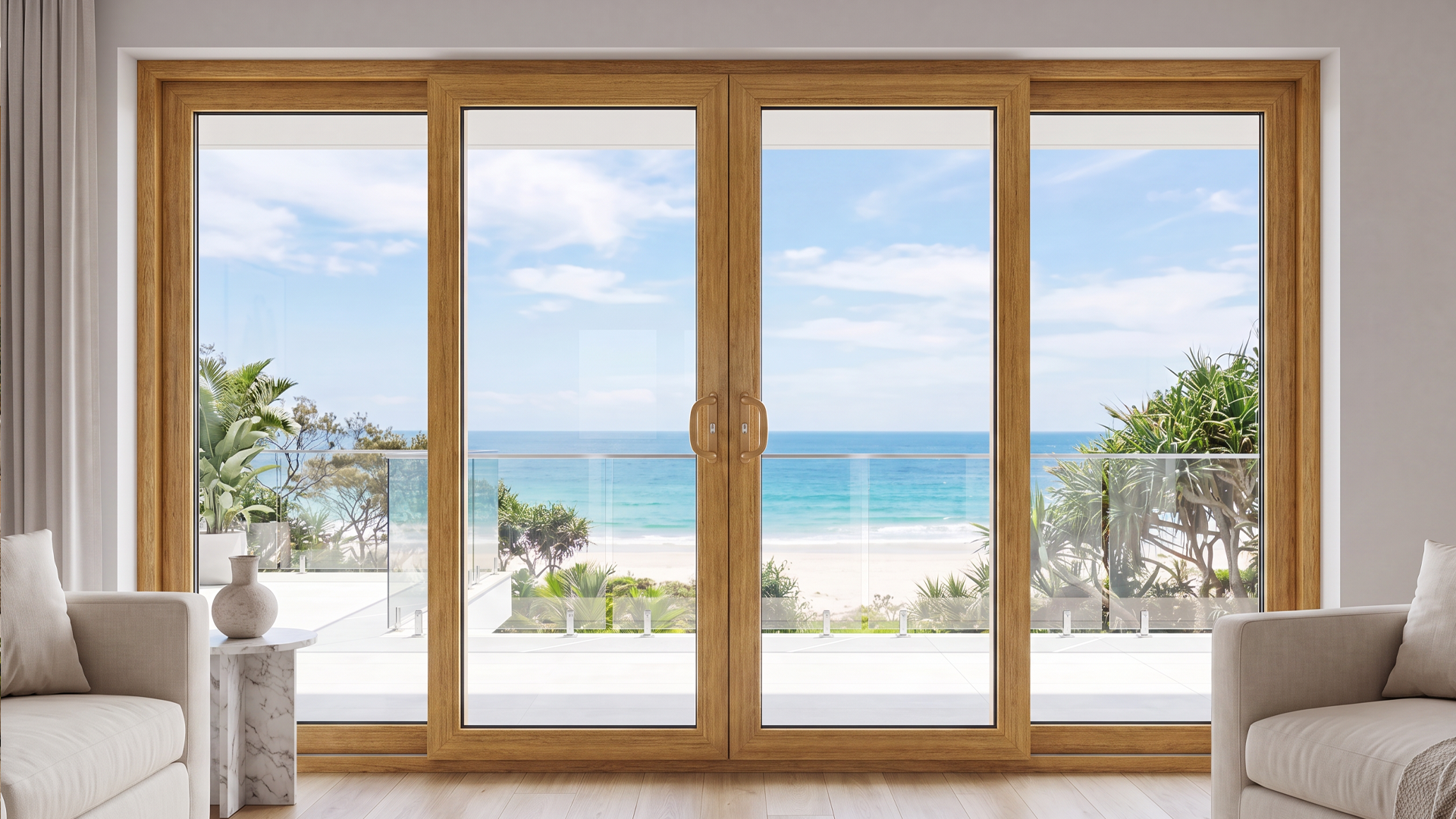
A uPVC window is only as good as the profile behind it. The profile is the extruded frame section that everything else attaches to — the glass, the hardware, the seals — and it decides how the window performs for the next twenty years.
Most buyers never see a profile cross-section. They see a finished window, a colour, and a price. But the differences that matter most are inside that extrusion, and they are the differences a quote rarely spells out.
This guide covers what to actually look at when comparing profiles, and why each factor matters in practice.
What a uPVC profile actually is
A uPVC profile is a hollow extruded bar with internal walls dividing it into chambers. Frames, sashes, mullions and beading are each a different profile shape, but they come from the same material and the same extrusion process.
Two things separate a good profile from a poor one: the geometry of those internal chambers, and the thickness of the walls between them. Everything else — colour, hardware compatibility, drainage — sits on top of those two fundamentals.
Eumax manufactures its own profiles at its Nelamangala plant rather than buying them in, which means the extrusion specification is set in-house rather than inherited from a supplier.
Chamber count: why the hollow sections matter
Cut a profile in half and you will see a series of sealed air pockets running along its length. Contemporary uPVC profiles typically have between three and six of these chambers.
Each chamber interrupts the path heat would otherwise take through the frame. Still air is a poor conductor, so a frame divided into more sealed pockets transfers less heat from outside to inside. That is the whole mechanism — there is no coating or additive doing the work, just geometry.
More chambers also mean more internal walls, which makes the section stiffer for the same outside dimensions. A five-chamber profile resists twisting better than a three-chamber profile of the same depth.
Chamber count is not a number to maximise blindly. A three-chamber profile in a small bathroom window facing an internal shaft is perfectly adequate. The chamber count should follow the demand on the window, not the marketing brochure.
Wall thickness: the specification most quotes omit
Wall thickness is the single most useful number to ask for, and the one least likely to be volunteered.
It refers to the thickness of the outer walls of the extrusion — the material between the outside air and the first chamber. Thinner walls use less material, so they cost less to produce. They also flex more, hold screws less securely, and are more likely to deform under sustained load or heat.
A profile that looks identical from the outside can have meaningfully different wall thickness from another. You cannot tell by looking at an assembled window. You have to ask, and a manufacturer that sets its own extrusion specification will be able to tell you without checking with anyone.
For reference: the Eumax casement series is manufactured with section wall thicknesses in excess of 2.5mm. Ask any supplier for the equivalent figure and for the profile data sheet that supports it.
Steel reinforcement: what stops a frame bowing
uPVC on its own is not stiff enough for larger openings. Galvanised steel sections are inserted into the main chamber of the frame and sash and screwed in place during fabrication.
This is where corners get cut, because reinforcement is invisible once the window is assembled. A window can be delivered with steel in the frame but not the sash, or with steel of a lighter gauge than the span requires, and it will look identical to a correctly reinforced one on the day it is installed. The difference appears two summers later as a sash that no longer closes squarely.
Ask specifically whether reinforcement is included in all frame and sash members, not just the frame. Get it in writing on the quote.
Larger spans and exposed elevations need heavier reinforcement. If you are glazing a full-height opening or a window on an upper floor facing open ground, raise it with your supplier rather than assuming the standard specification covers it.
Colour and finish
White remains the baseline, and it is also the most thermally forgiving choice — white reflects solar radiation rather than absorbing it, so the profile runs cooler and expands less.
Coloured profiles are produced in two ways, and the difference matters. A surface-applied coating sits on top of the extrusion and can chalk, fade or peel at the edges over time. A laminated profile has a decorative film bonded to the extrusion under heat and pressure before fabrication, which makes the finish part of the profile rather than a layer on it.
Eumax produces a laminated series in Walnut, Golden Oak, Metallic Grey, Dark Oak and Black, applied at the profile stage. When comparing a coloured window against another supplier's, ask which of these two methods was used — they are not equivalent products.
Darker laminates absorb more heat than white. In Bengaluru's climate this is rarely a structural concern, but it is worth factoring in for large west-facing openings.
Drainage and weather sealing
Every uPVC frame is designed to let water out. Small drainage channels are routed through the bottom of the frame so that rain driven past the outer seal collects and exits rather than pooling inside the section.
These channels are easy to overlook and easy to block. Poorly executed drainage is one of the most common causes of a window that leaks in heavy monsoon rain despite being new. Ask how the drainage is arranged and whether the slots are cut at fabrication or moulded into the extrusion.
Gasket quality matters as much as the profile. EPDM gaskets stay flexible far longer than cheaper alternatives, which harden and shrink, opening gaps at the corners after a few years of thermal cycling.
Matching the profile to your climate and site
The same profile is not the right answer everywhere. A few site conditions change the specification:
- Road-facing elevations. Noise is a sealing problem before it is a glass problem. A casement profile with a compressed perimeter gasket will outperform a sliding profile with a brush seal, whatever glass goes into it.
- Coastal locations. Salt-laden air attacks hardware and reinforcement long before it affects the uPVC. Specification changes here are about the steel and the hardware, not the profile.
- Exposed upper floors. Higher wind loading means heavier reinforcement and, often, a deeper profile series.
- Large spans. Beyond a certain width, a deeper profile is not optional — it is what stops the frame bowing under its own glass weight.
Hardware compatibility
Profiles and hardware are designed as systems. The groove that accepts a lock, the geometry of a hinge seat, the track a roller runs in — these are dimensioned for particular hardware families.
Substituting hardware from outside the specified range can work mechanically while still compromising the seal, because the compression the gasket was designed around is no longer being applied evenly. It can also affect warranty cover.
If a supplier offers to fit different hardware to reduce cost, ask whether it is within the profile system's specification.
Manufacturer, warranty and test certificates
Ask who made the profile, not just who fabricated the window. These are frequently different companies, and when a profile-level defect appears, a fabricator can only pass the claim up the chain.
Ask for test certificates, and ask who issued them. In-house lab results and results from a government-recognised third-party lab are not the same thing, and a manufacturer confident in its product will have both.
On warranty, read what is actually covered. Profile warranty, hardware warranty and workmanship warranty are usually three separate things with three different durations. A warranty covering material defects but not fabrication quality is considerably weaker than it sounds.
Cost versus value
Profile choice is one of the larger levers on the final number, and it is also the one where a saving is hardest to see and easiest to regret.
A thinner-walled, fewer-chambered profile with lighter reinforcement will quote lower. It will also be the component you cannot upgrade later without replacing the entire window. Glass can be changed. Hardware can be changed. Handles, mesh and grilles can be added afterwards. The profile is permanent.
That asymmetry is the argument for specifying the profile properly and economising elsewhere if the budget needs it.
Getting it right for your project
Specify each opening for what it has to do rather than applying one profile across the whole house. A bathroom window facing an internal shaft and a bedroom window facing an arterial road have genuinely different requirements, and treating them identically means overpaying on one and under-specifying the other.
Ask for the profile data sheet. Ask for the wall thickness. Ask whether reinforcement covers frames and sashes. A supplier who can answer those three questions without hesitation is telling you something useful about how the rest of the job will go.
Want a quote for your own openings?
Our team covers Bengaluru and surrounding areas.