
Getting a quote for new windows in Bengaluru can feel like buying a car. The base price sounds fine, then extras add up, and suddenly you are paying well above the number you budgeted.
uPVC window costs vary more than most buyers expect, and the reason is not arbitrary. There are real variables at work, and once you understand them, a quote stops being a mystery and starts being something you can actually evaluate.
This guide is written by Eumax (Eureka Windoor Systems Pvt. Ltd.), a Bengaluru-based uPVC windows and doors manufacturer operating out of Nelamangala. We make our own profiles in-house and supply finished windows across Bengaluru and surrounding areas. That means we see the full cost chain: raw material, fabrication, hardware, installation. What follows is an honest breakdown of where that money goes.
We do not publish per-square-foot rates, for a simple reason: they go stale, and a number quoted out of context sets an expectation that a real site measurement then has to unpick. What we can do is show you exactly which decisions move the number, and by roughly how much relative to each other. That is the information you actually need when comparing two quotes.
Why uPVC makes sense for Bengaluru homes specifically
Before getting to cost, it is worth a minute on why this material gets chosen at all. Bengaluru has a relatively mild climate by Indian standards, but it is not without challenges. Monsoon season brings sustained humidity and wind-driven rain. Summer temperatures in flats with western exposures regularly push above 35 degrees indoors. And traffic noise on arterial roads like Outer Ring Road or Bellary Road is a genuine quality-of-life problem for apartments that face them.
uPVC addresses all three. The material does not swell or warp with humidity the way timber does. Its thermal conductivity is dramatically lower than aluminium, which reduces heat gain through the frame. And casement uPVC windows, when properly gasket-sealed, can reduce noise transmission significantly compared to a standard sliding aluminium window with worn seals.
Over a 20 to 25 year lifespan, uPVC requires no repainting, no anti-rust treatment, and no pest treatment. That zero-maintenance reality is why it has been the dominant window material in Europe for four decades and is now growing rapidly in Indian tier-1 cities.
The question is not really whether uPVC is worth it. The question is what the right specification is for your project, and what that specification will cost.
Eight factors that drive the cost
Every line item in a uPVC windows quote exists for a reason. Here are the eight factors that account for most of the variation you will see across suppliers and specifications.
1. The profile system and series
The profile is the extruded uPVC bar that forms the frame and sash of your window. Its width — typically expressed in millimetres: 50mm, 60mm, 80mm, 88mm — determines how many internal chambers it has, how thick the walls are, and how large a glazing unit it can carry. Wider, multi-chamber profiles cost more to manufacture and weigh more, but they deliver better thermal insulation and can handle larger openings without bowing.
Eumax manufactures its own uPVC profiles at its Nelamangala plant, covering sliding series from 50mm to 108mm and a 60mm casement system. The 60mm sliding series is suitable for most standard residential windows. The 80mm and 88mm systems are specified for larger spans or where higher wind resistance is needed. The 108mm system is for commercial-scale applications.
A supplier offering a flat rate regardless of profile depth is either using the same profile for everything — which means some openings are under-specified — or is not disclosing the upgrade charges.
2. Window type and opening mechanism
Sliding windows use a two- or three-track system where the sash panels roll along horizontal tracks. They are mechanically simpler and cheaper to produce than casement windows. The trade-off is that the seal between a sliding sash and its frame is a brush or pile seal, not a compressed gasket, which means slightly lower air-tightness.
Casement windows open on hinges and close against a continuous perimeter gasket. The seal is significantly better, which matters for rooms where noise reduction or air conditioning efficiency is a priority. Casement fabrication requires more hardware — hinges, espagnolette locks, casement stays — and more machining time, which typically pushes the cost up by 20 to 40 percent compared to a comparable sliding window.
Eumax offers both sliding and casement configurations across its product range, plus combination, fixed, bay, bi-fold, and designer door options. Choosing the right type for each room, rather than one type for the whole project, is often the smarter approach.
3. Glass specification: single vs double glazing
Glass is one of the largest single components of a finished window, typically accounting for somewhere between a quarter and a third of the total. Choosing between single and double glazing is therefore one of the biggest budget decisions in a project.
Single glazing — a single pane, typically 4mm or 5mm thick — is the baseline. It provides basic protection from weather but does not significantly reduce heat gain or noise. For rooms that are rarely air-conditioned and face quiet internal courtyards, single glazing is a reasonable choice.
Double-glazed units consist of two panes with a sealed air or argon-filled gap between them, typically 12mm to 16mm. The thermal resistance of a standard double-glazed unit is roughly four times that of single glazing. For any room with air conditioning or significant road noise, the energy savings over three to five years will usually recover the additional cost.
Acoustic laminated glass, which uses a PVB interlayer between two panes, is used where noise reduction is the primary goal. Tinted glass or low-emissivity coatings are used in south and west-facing windows to reduce solar heat gain. Each of these upgrades adds to the glass cost.
Important: Eumax manufactures and supplies uPVC profiles, frames and hardware. Glass is procured separately by clients or installation teams according to the project specification. Eumax does not sell glass as a product, so any glass cost sits outside an Eumax quotation.
4. Window size and total area
uPVC windows are generally quoted per square foot of overall frame size. But size affects cost in a non-linear way. A large window is not simply proportionally more expensive than a small one. Larger frames need steel reinforcement of a heavier gauge, longer runs of hardware, and more careful installation to keep the frame square during fitting.
On the other hand, very small windows — under about four square feet — can cost more per square foot than mid-size windows, because the fixed setup and fabrication costs of corner welding, hardware fitting and quality checking are spread over fewer square feet.
If you are buying multiple windows for a project, total area matters. Most suppliers work on a sliding scale where a higher total area means a better per-unit rate.
5. Hardware quality and brand
Hardware includes handles, locks, hinges, rollers for sliding systems, and gaskets. This is one of the most underestimated cost variables in a uPVC window quote.
A standard zinc die-cast handle with a single-point lock sits at the bottom of the range. A multi-point locking system from a European hardware brand can cost several times as much per window before fitting. The functional difference is real: a multi-point lock engages at three or more points around the frame when you close the window, creating even gasket compression all around the sash. A single-point lock only pulls the frame tight at one spot.
Roller quality determines how long a sliding window operates smoothly. Cheap nylon rollers wear within two to three years on heavy panels. Stainless steel or heavy-duty nylon rollers with bearings last significantly longer and handle heavier glass weights without binding.
Eumax specifies hardware from verified suppliers that are compatible with the profile series. Substituting hardware from outside the specified range can affect both fit and warranty.
6. Frame colour and laminated finishes
Standard white uPVC is the base price point. It is also the most durable finish, because white reflects solar radiation rather than absorbing it, which reduces thermal stress on the profile.
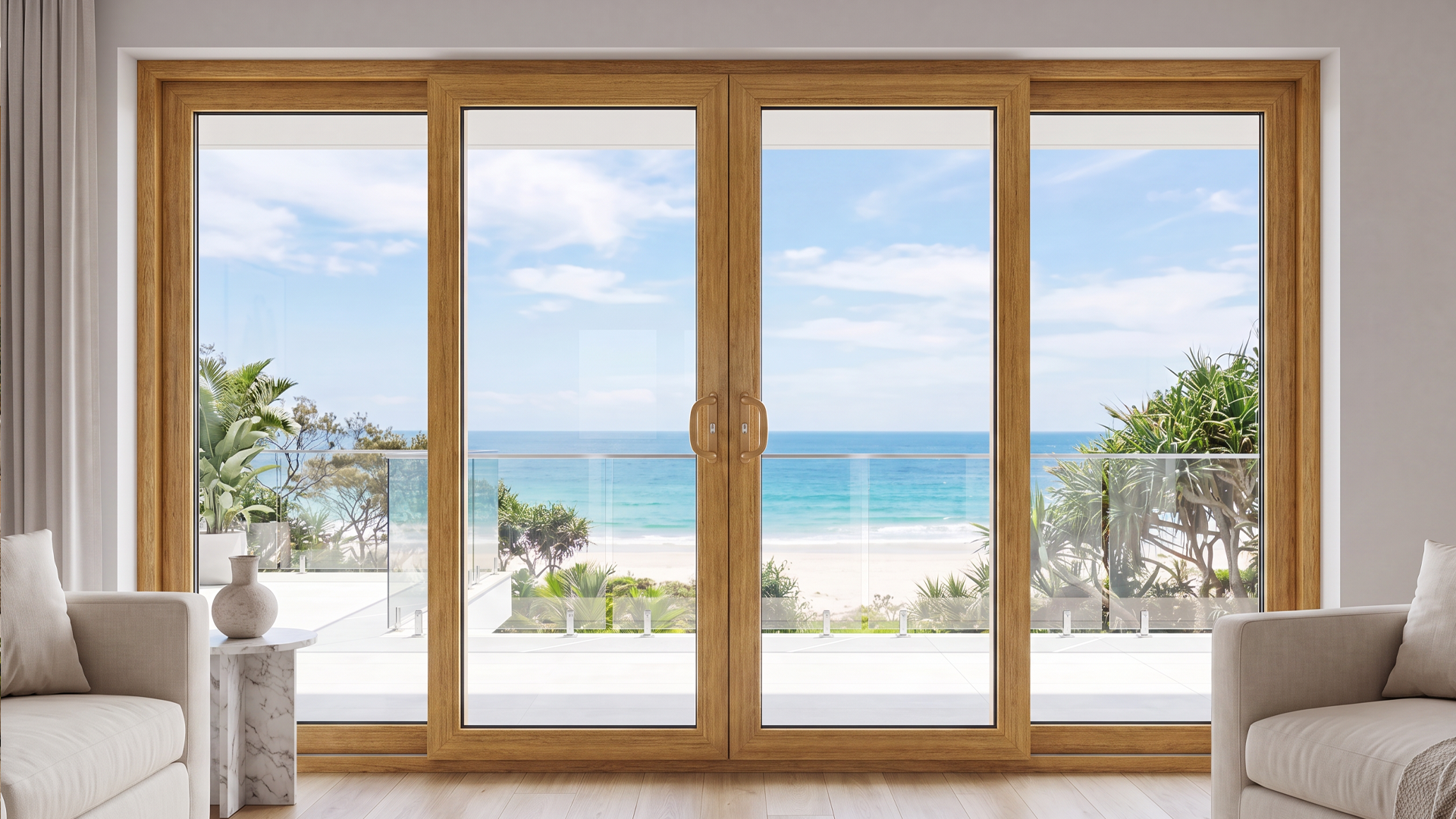
Coloured and laminated profiles cost more. Eumax offers a laminated series where profiles are manufactured with a factory-bonded decorative film in Walnut, Golden Oak, Metallic Grey, Dark Oak and Black. Depending on the finish, a laminate typically adds somewhere in the region of 20 to 35 percent over the equivalent white profile, because the lamination process is done separately before fabrication and the cut ends and weld areas require additional sealing steps.
Foiled profiles in dark colours do absorb more heat than white profiles and should be specified with that in mind for south or west-facing openings. Bengaluru's climate is mild enough that this is rarely a structural problem, but it is worth knowing.
7. Installation complexity and site conditions
Installation is usually quoted as a separate line and commonly adds somewhere between a fifth and a third on top of the supply price. What drives the variation is site condition.
Replacing an existing window in an already-formed opening is relatively straightforward. The old frame is removed, the new frame is set into the opening, levelled, and fixed. Any gap between the new frame and the masonry is filled with polyurethane foam and sealed. This takes two to four hours per window for a skilled two-person team.
New construction or modification of existing openings is more involved. If the opening needs to be widened or a lintel moved, masonry work happens before installation. After the window is in, the finish plaster and paint around the frame needs redoing. These civil works are usually quoted separately and should be confirmed in writing before you accept a quote.
Floor level matters too. Ground-floor installations require no scaffolding. Upper floors typically need scaffolding or rope access for external work. For high-rise projects in Bengaluru, floor-level surcharges from installation teams are standard practice.
8. Grilles, mosquito mesh and accessories
Several common additions are priced separately from the base window. Mosquito mesh is one of the most requested in Bengaluru given the city's monsoon season. Fitted mesh frames slide or fold within the window track system; fibreglass mesh is the cheaper option, while stainless steel mesh costs more but lasts longer.
Grilles, internal or external, are often requested for ground-floor or lower-floor windows. Steel grilles are fabricated separately and either welded into the frame or fitted as a removable insert. Decorative uPVC grille bars can be applied internally to divide the glass aesthetically without reducing the clear opening.
Door closer mechanisms, fly screens, roller shutters and child-safety restrictors are further add-ons that your supplier should price separately. Always ask for an itemised quote so you can see what is in the base price and what is being added on.
Budget vs premium: where the costs actually scale
The table below maps the key specification choices against their budget and premium expressions, so you can see which decisions move the number most.
| Factor | Budget option | Premium option |
|---|---|---|
| Glazing | Single (4mm clear) | Double-glazed unit with acoustic or tinted glass |
| Profile system | 50mm or 60mm sliding | 88mm or 108mm, casement or laminated |
| Hardware | Standard handle and single-point lock | Multi-point lock, branded European hardware |
| Colour / finish | White (standard) | Woodgrain, grey or Metallic Grey laminate |
| Installation | Simple replacement, no civil work | New opening, masonry rework, grouting |
A fully specified casement window with a double-glazed unit, branded multi-point locks and a laminated finish can come to several times what a basic sliding window with single glass and standard hardware costs. Neither end of that range is wrong. What matters is matching the specification to the actual requirement of each room.
uPVC vs aluminium vs wood: the honest comparison
Buyers often compare uPVC against aluminium and timber. Here is how they actually stack up.
Aluminium windows
Standard aluminium sliding windows look cheaper than uPVC on the initial quote. But standard aluminium frames are not thermally broken. They conduct heat readily, which increases the thermal load on air-conditioned spaces. Thermally broken aluminium frames, which have a polymer insert to interrupt the thermal path, cost substantially more — enough to put them squarely in uPVC territory or above.
Aluminium corner joints are mechanical, not welded. Over time the corner keys can loosen, creating small gaps that let in air and eventually water. uPVC corners are fusion welded, which makes the corner monolithic when done correctly.
Aluminium does hold an advantage in one scenario: very large commercial openings where structural stiffness over spans greater than 2.5 metres is needed without additional reinforcement. For standard residential openings, uPVC with steel reinforcement is more than adequate.
Timber windows
Hardwood timber windows from established suppliers start at a level comparable to mid-range uPVC. But timber requires repainting every three to four years and anti-pest treatment regularly. Across a 25-year period, maintenance costs on timber can easily equal or exceed the original purchase cost.
Timber also moves with moisture. Bengaluru's monsoon seasons introduce and then withdraw humidity from the air repeatedly over the year. Wood swells slightly in the wet season and shrinks in the dry season. This seasonal movement affects seals and can cause frames to bind or gaps to appear. uPVC does not move with humidity, and that dimensional stability is a meaningful practical advantage in Bengaluru's climate.
How to compare quotes fairly
Get itemised quotes, not package prices
Always ask for a quote that breaks down profile, hardware and installation separately. A single all-in rate makes it impossible to understand what you are comparing across suppliers. One supplier's rate might include branded hardware and a double-glazed unit; another's might be single glass with generic locks. The only way to compare fairly is to line up the same specification.
Understand the profile specification
Ask which profile series is being used for each window type and request the profile data sheet. A reputable manufacturer will have this. Check the main frame wall thickness and the number of chambers. If the supplier cannot provide this information, that tells you something.
Do not over-specify across the board
Not every window needs the same specification. A bathroom window facing an internal shaft does not need a double-glazed unit or premium hardware. A bedroom window facing Outer Ring Road with an air conditioner in it probably does. Spec each window for its actual use case rather than applying one specification to all openings.
Prioritise fabrication quality over brand markup
In the Bengaluru uPVC market you will see a wide range of supplier names, from local fabricators to national brands. A national brand name does not guarantee better fabrication. What matters is whether the work is done on proper CNC equipment with calibrated welding machines, correct steel reinforcement and verified hardware fitting. Ask to visit the fabrication facility, or at minimum ask about the equipment used.
Eumax runs a dedicated fabrication training centre at Nelamangala and trains its channel partners directly, so windows supplied through the Eumax dealer network follow a verified fabrication process rather than an informal one.
Confirm what the warranty covers
Read what the warranty actually covers. A warranty that covers material defects but not workmanship issues is much weaker than one covering both. Also ask what the resolution process is if you find a defect after installation. For a Bengaluru-based buyer, a supplier with a local service presence is meaningfully different from one without it.
Measure accurately before ordering
uPVC windows are custom-fabricated to your opening dimensions. Unlike aluminium or timber, you cannot trim a finished uPVC frame on site. Always have opening dimensions measured by the supplier or a qualified person before the cut list is prepared. For irregular openings, share photos and ask for a site visit.
Ask what is not included
Confirm explicitly what the quote excludes. Civil works such as plastering and painting around frames, mosquito mesh, glass, disposal of old frames and scaffolding are all commonly excluded from base uPVC window quotes. These exclusions can add a meaningful percentage to a quote you thought was final, so ask upfront.
Ten questions to ask any supplier before you sign
- Which profile series is being used, and what is the main frame wall thickness?
- Does the price include steel reinforcement in all frame and sash members?
- What glass specification is assumed, and who is supplying it?
- Which hardware brand is being used for handles and locks?
- Is installation included, and does it cover civil patching around the frame?
- What warranty is offered on profiles versus hardware, and what does each cover?
- Does the company have a service team based in Bengaluru?
- Can mosquito mesh, grilles or other accessories be added later if not ordered now?
- What is the lead time from order to installation?
- Will you provide a site visit and take measurements before finalising the quote?
Why Bengaluru buyers choose Eumax
Eumax is not the only uPVC supplier in Bengaluru. But it occupies a specific position in the market that makes it worth considering alongside the national brands.
The company manufactures its own profiles at Nelamangala, which means it controls raw material quality, extrusion parameters and profile specifications from the start. Most Bengaluru window companies are fabricators who buy profiles from external suppliers. When something goes wrong — a profile crack, a dimensional issue, a surface defect — the fabricator depends on the profile supplier to acknowledge and resolve it. Eumax does not have that gap.
The Eumax profile range covers the full spread of residential and commercial requirements: five sliding series from 50mm to 108mm, a 60mm casement system, a laminated series, and a full range of window and door types including sliding, casement, fixed, combination, bay, bi-fold and designer doors.
The company also runs a fabrication training centre that certifies channel partners, which means the fabrication quality of Eumax-branded windows follows a verified process rather than an informal one. For buyers, that is a practical assurance that matters more than marketing language.
Price is what you pay, value is what you get
The cost of uPVC windows in Bengaluru is not a single number. It is shaped by the profile series, the glass, the hardware, the finish, the installation complexity and the accessories you choose. That is precisely why a published rate card would mislead more than it helps.
What matters is matching the specification to the actual requirement of each room and opening, then getting that specification priced transparently by a supplier who can deliver what they quote. The questions in this guide will help you do that.
Good windows are not an expense. They are one of the few home improvements that pay you back in reduced maintenance, lower energy bills and better daily comfort for the entire time you live in the building.
Frequently asked questions
How long does it take to get uPVC windows installed in Bengaluru after ordering?
Standard lead time for fabrication and delivery after site measurement is 10 to 20 working days for most residential orders. Larger orders, custom profiles or laminated frames take longer. Installation itself typically takes one to three days for a standard 2 to 3 BHK flat depending on the number of windows and whether any civil work is involved.
Is it cheaper to buy uPVC windows directly from a manufacturer like Eumax?
Buying from a manufacturer that also fabricates and installs removes one or two layers of intermediary margin. In practice you also get a cleaner accountability chain: one company is responsible for the profile, the fabrication and the installation, which simplifies any post-installation service claim.
Do uPVC windows reduce electricity bills in Bengaluru?
For air-conditioned spaces with a double-glazed unit and a well-sealed casement system, the reduction is measurable. The exact saving depends on the size of the glazed area, the glass specification and how heavily the air conditioning runs. Homes with large west-facing glass areas typically see the most impact.
Does Eumax supply the glass as well as the frames?
No. Eumax manufactures and supplies uPVC profiles, frames and hardware. Glass is procured separately by clients or installation teams according to the project specification.
Can Eumax windows be ordered in colours other than white?
Yes. Eumax offers a laminated series in Walnut, Golden Oak, Metallic Grey, Dark Oak and Black, available across the sliding and casement series. The laminate is factory-applied to the profile before fabrication, so the finish is consistent and does not need periodic reapplication.
Want a quote for your own openings?
Our team covers Bengaluru and surrounding areas.

