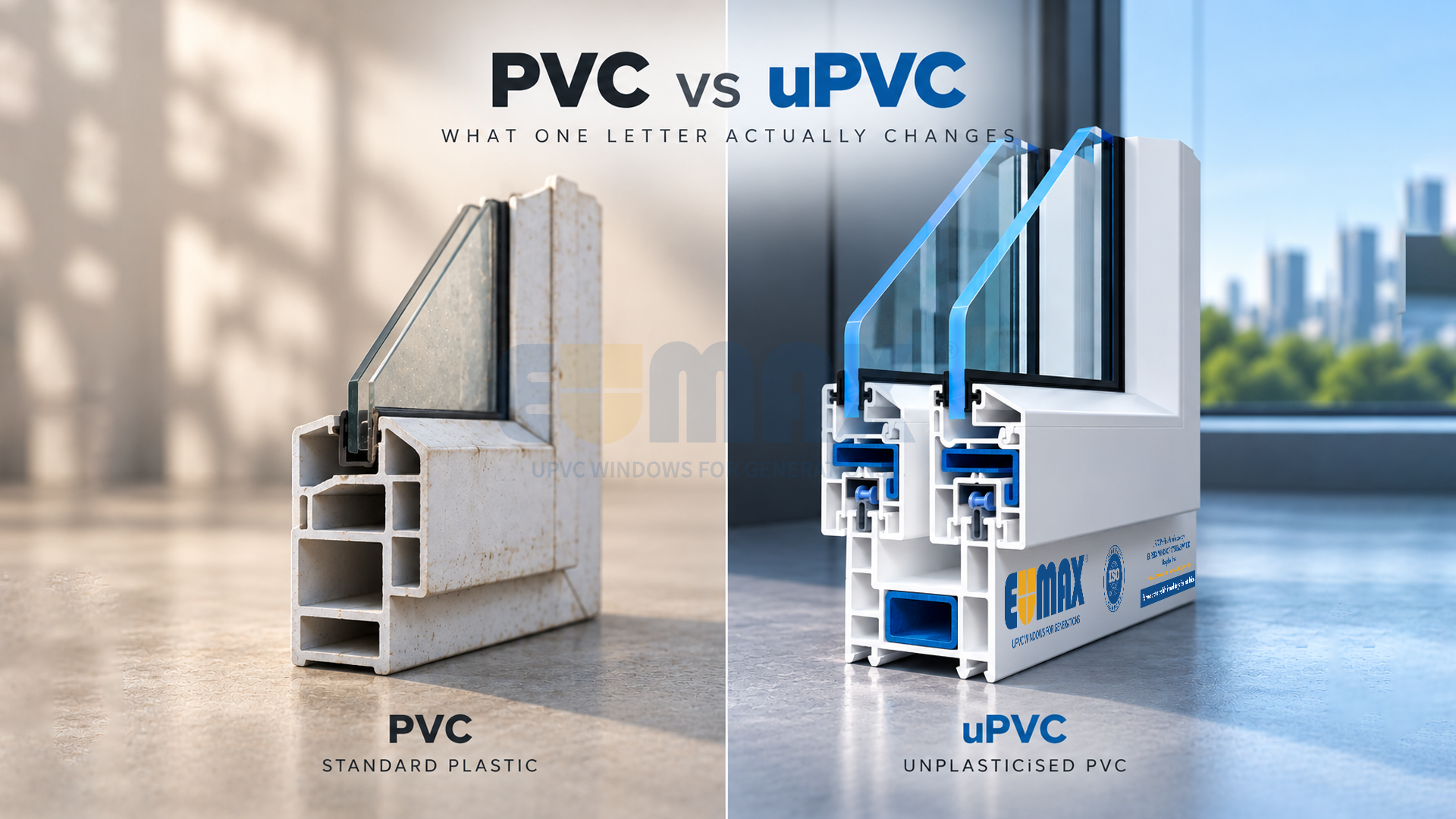
CPVC and uPVC sound similar, belong to the same polymer family, and are used for entirely different things. Confusing them is common, and it occasionally leads to someone being offered the wrong product.
The short version: uPVC is a window and door material. CPVC is a plumbing material. Neither does the other's job well.
What each one is
uPVC — unplasticised polyvinyl chloride
PVC with the plasticisers left out, producing a rigid material that holds its shape. Formulated with UV stabilisers and impact modifiers, extruded into hollow multi-chamber profiles, and reinforced with steel where spans require it.
Built for structural rigidity, weather resistance and thermal insulation.
CPVC — chlorinated polyvinyl chloride
PVC that has undergone additional chlorination, raising its chlorine content. That change does one thing very well: it raises the temperature the material can handle. Standard PVC softens at temperatures a domestic hot water system reaches routinely; CPVC does not.
Built for hot water distribution.
The comparison
| Property | uPVC | CPVC |
|---|---|---|
| Primary use | Windows, doors, profiles | Hot and cold water plumbing |
| Chlorine content | Standard for PVC | Raised through chlorination |
| Heat tolerance | Suited to ambient exterior conditions | Handles sustained hot water temperatures |
| Form | Extruded hollow multi-chamber profiles | Solid-wall pipe and fittings |
| Reinforcement | Steel inserts in frames and sashes | None — pressure handled by wall thickness |
| UV stabilisation | Formulated in, for permanent sun exposure | Not designed for prolonged UV exposure |
| Joining method | Fusion welded corners | Solvent cement |
Why CPVC is not a window material
This matters because it occasionally appears in marketing, and it is worth being able to recognise.
Form. CPVC is manufactured as solid-wall pipe. Window performance depends on multi-chamber hollow geometry — the sealed air pockets are what provide thermal insulation. That geometry is not what CPVC production is set up to make.
UV exposure. CPVC is formulated for pipework, which typically runs inside walls or under insulation. A window frame sits in direct sun for its entire life, which is why window-grade uPVC carries UV stabilisers as a core part of its formulation.
Structural role. A window frame carries glass weight and resists wind load across a span. A pipe resists internal pressure. These are different mechanical problems calling for different sections.
If a supplier offers CPVC window profiles, that is a reason to ask questions rather than to be impressed by the terminology.
Where each belongs in a building
In a typical house both materials are present, doing separate jobs.
CPVC runs hot and cold water to bathrooms and the kitchen, usually concealed in walls and floors.
uPVC forms the windows and doors, exposed to weather and sun, carrying glass and providing the building's thermal and acoustic envelope at every opening.
They rarely meet, and neither is a substitute for the other.
A note on PVC-U and other labels
You will encounter several names for the same thing. PVC-U is the same material as uPVC — the European naming convention places the modifier after the polymer. Rigid PVC is another term for it.
What is not the same is plain PVC, which usually implies the plasticised, flexible version. And ABS is a different polymer entirely, unrelated to either — if a window is described as ABS, the description is wrong.
What to ask
If you are buying windows and CPVC has come up in the conversation, the useful questions are straightforward.
- Which material is the profile actually made from?
- What is the wall thickness of the main frame section?
- How many chambers does the section have?
- Is the profile UV stabilised, and how?
- Is steel reinforcement included in frames and sashes?
A manufacturer that extrudes its own profiles will answer all five immediately. Eumax produces its profiles at Nelamangala, so the specification comes from the same company that supplies the finished window.
The summary
Both materials are members of the PVC family. That is roughly where the similarity ends.
CPVC exists because plumbing needed a plastic that tolerates hot water. uPVC exists because windows needed a rigid, UV-stable, thermally insulating profile. Each is well designed for its purpose and poorly suited to the other's.
Frequently asked questions
What is the difference between CPVC and uPVC?
uPVC is unplasticised PVC, extruded into rigid multi-chamber profiles for windows and doors. CPVC is PVC that has undergone additional chlorination, which raises the temperature it can tolerate and makes it suitable for hot water plumbing. They belong to the same polymer family and are built for entirely different jobs.
Can CPVC be used for window frames?
It is not suited to it. CPVC is manufactured as solid-wall pipe rather than multi-chamber profile, so it lacks the sealed air pockets that give a window frame its thermal performance. It is also formulated for pipework that runs concealed, not for permanent UV exposure, and it is designed to resist internal pressure rather than carry glass weight across a span.
Is PVC-U the same as uPVC?
Yes. PVC-U is the European naming convention for the same material, and rigid PVC is another term for it. What is not the same is plain PVC, which usually implies the plasticised flexible version, or ABS, which is a different polymer entirely.
Want a quote for your own openings?
Our team covers Bengaluru and surrounding areas.