
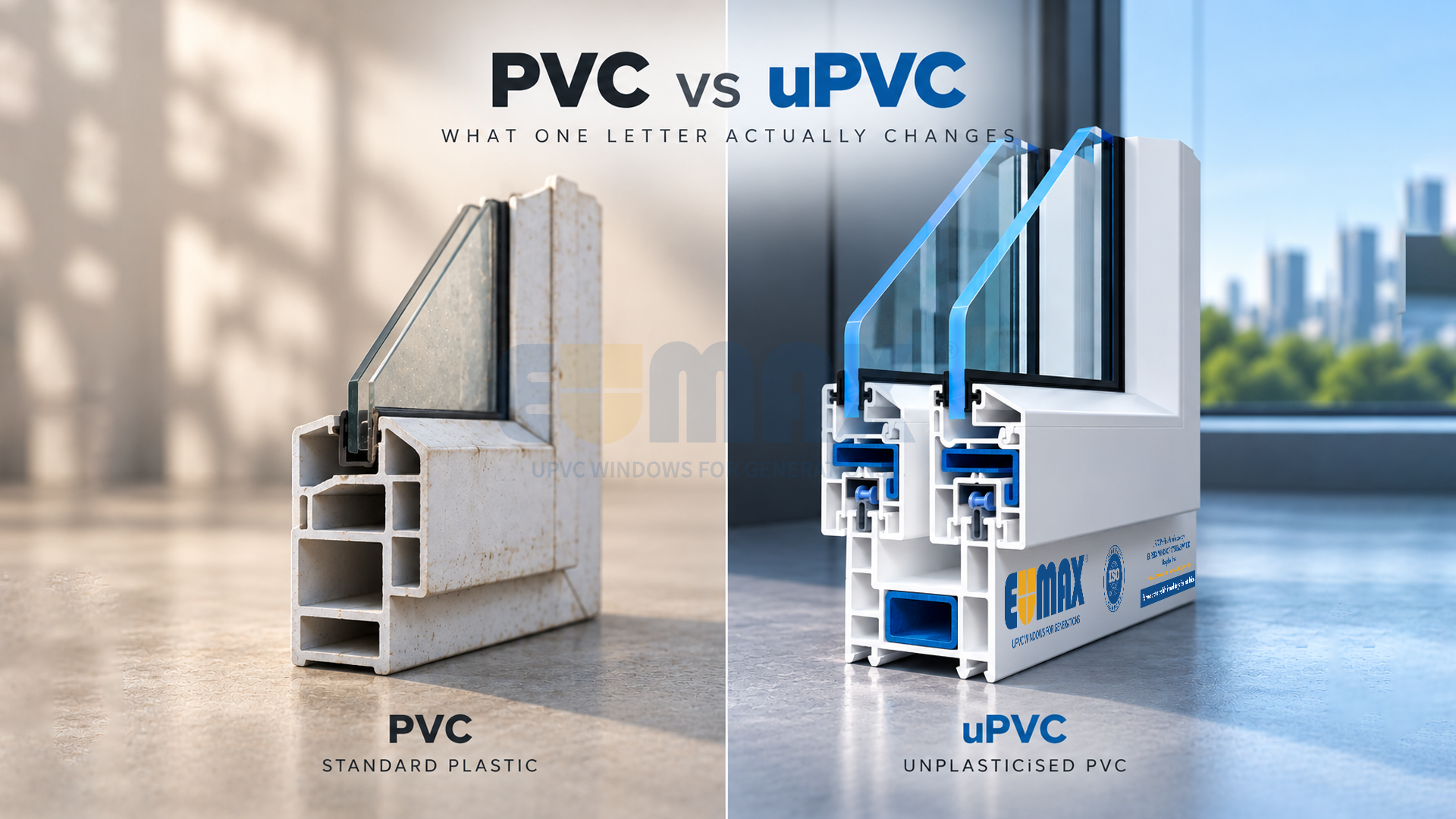
One letter separates PVC from uPVC, and it changes what the material is for. The difference comes down to a single class of additive — plasticisers — and whether they are present.
What plasticisers do
Polyvinyl chloride in its raw state is rigid and brittle. To make it usable in flexible applications, manufacturers add plasticiser compounds that sit between the polymer chains and let them slide past one another.
The result is a material that bends without breaking. That is what makes flexible PVC useful for cable insulation, flooring, hoses and packaging.
uPVC — unplasticised PVC — leaves them out. The polymer chains stay locked together, and the material stays rigid.
Why that matters for a window
Three consequences follow directly from the presence or absence of plasticisers.
Rigidity over time
A window frame carries glass weight continuously for decades. A flexible material would creep — deforming slowly under sustained load — and a frame that creeps stops sealing.
Rigid uPVC holds its geometry. This is the fundamental reason windows use the unplasticised version.
Plasticiser migration
Plasticisers are not chemically bonded into the polymer. Over years, particularly under heat and UV, they gradually migrate out of the material.
As they leave, the plastic becomes progressively harder and more brittle — which is why old flexible PVC items eventually crack. A window frame subject to that process would fail in a way that gets worse rather than stabilising.
uPVC has no plasticisers to lose, so it does not follow that curve.
UV resistance
Plasticised PVC degrades faster under sustained sun. Window-grade uPVC is formulated with UV stabilisers as a core component, because a window frame is in direct sunlight for its entire service life.
A quick comparison
| Property | PVC (plasticised) | uPVC (unplasticised) |
|---|---|---|
| Flexibility | Flexible, bends easily | Rigid, holds its shape |
| Plasticisers | Present | None |
| Behaviour over time | Hardens as plasticisers migrate out | Stable, no migration path |
| UV performance | Degrades under sustained exposure | Formulated with UV stabilisers |
| Structural load | Creeps under sustained load | Holds geometry |
| Typical use | Cables, flooring, hoses, packaging | Windows, doors, profiles, drainage |
Naming conventions
Several labels describe the same material, which adds unnecessary confusion.
uPVC and PVC-U are the same thing — the European convention places the modifier after the polymer name. Rigid PVC is another term for it.
Plain PVC in a product description usually implies the plasticised version, though it is sometimes used loosely as a catch-all. If a window is described simply as "PVC", it is worth asking which is meant.
And CPVC is a third material again — PVC with additional chlorination, formulated for hot water plumbing rather than for windows.
Does the distinction matter in practice?
Honestly, most reputable window suppliers in India are selling unplasticised PVC whether or not the label says so. Nobody is manufacturing window frames from flexible PVC, because they would not work.
Where the distinction matters is in what it tells you about a supplier's precision. A company that describes its product accurately tends to be precise about the things that are variable — wall thickness, chamber count, reinforcement, UV formulation.
Those are the specifications that genuinely differ between products, and they are what to focus your questions on.
The specifications that actually vary
Since every window-grade profile is unplasticised, comparison should move to the things that differ:
- Wall thickness of the main frame section — governs rigidity and screw retention, and is invisible on an assembled window.
- Chamber count and arrangement — determines thermal performance and section stiffness.
- UV stabiliser quality — what keeps the surface from chalking after a decade of Indian sun.
- Impact modifier content — what stops the material becoming brittle.
- Steel reinforcement — present in frames and sashes, or only one of them.
A manufacturer that extrudes its own profiles sets all five in-house. Eumax produces its profiles at Nelamangala, which means these are specification decisions rather than inherited properties.
The one-line answer
PVC is flexible because plasticisers were added. uPVC is rigid because they were not. Windows need rigidity, so windows use uPVC — and the interesting questions start after that.
Frequently asked questions
What is the difference between PVC and uPVC?
Plasticisers. Standard PVC has plasticiser compounds added that let the polymer chains slide past one another, making it flexible. uPVC leaves them out, so the material stays rigid. Flexible PVC suits cables, flooring and hoses; rigid uPVC suits windows, doors and profiles.
Why does plasticiser migration matter for windows?
Plasticisers are not chemically bonded into the polymer, so over years — particularly under heat and UV — they gradually migrate out. As they leave, the plastic becomes harder and more brittle, which is why old flexible PVC eventually cracks. uPVC has no plasticisers to lose, so it does not follow that curve.
If all window profiles are uPVC, what should I compare instead?
Wall thickness of the main frame section, chamber count and arrangement, UV stabiliser quality, impact modifier content, and whether steel reinforcement is present in both frames and sashes. These are the specifications that genuinely differ between products, and none of them are visible on an assembled window.
Want a quote for your own openings?
Our team covers Bengaluru and surrounding areas.


