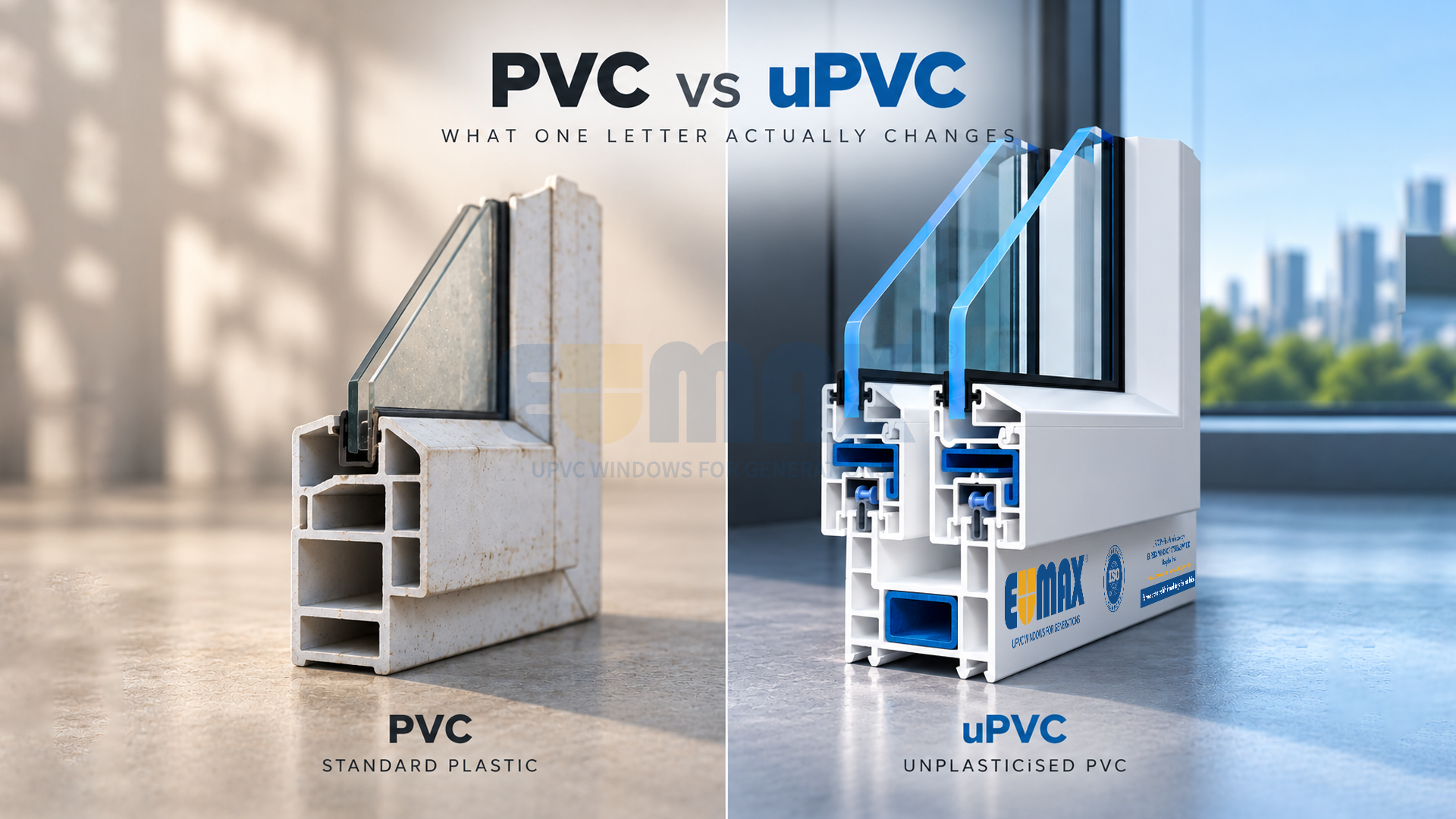
uPVC stands for unplasticised polyvinyl chloride. The word that matters is the one in the middle — unplasticised — because it is the difference between a material that stays rigid for decades and one that does not.
What the name actually means
Polyvinyl chloride is a common plastic. On its own it is hard and brittle, so manufacturers usually add plasticisers — compounds that make it flexible. That flexible version is what becomes cable insulation, flooring and pipes.
uPVC leaves the plasticisers out. What remains is rigid, dimensionally stable and does not soften with age. Those are exactly the properties a window frame needs, and exactly the ones a flexible plastic cannot offer.
This is why the distinction is not pedantic. A frame made from plasticised PVC would sag under its own glass weight within a few years.
How a profile is made
The compound is extruded — heated and pushed through a shaped die that forms a continuous hollow section, which is cooled and cut to length.
Two things are determined at this stage and cannot be changed afterwards.
Chamber geometry. The die shape sets how many sealed internal chambers the section has and how they are arranged. More chambers means better thermal performance, because still air is a poor conductor and each chamber interrupts the heat path.
Wall thickness. How much material sits between the outside air and the first chamber. Thicker walls mean a stiffer section that holds screws better and resists deformation. Thinner walls cost less to produce and flex more.
Neither is visible on an assembled window, which is why both are worth asking about.
Eumax extrudes its own profiles at Nelamangala rather than buying them in, so the specification is set in-house rather than inherited.
What goes into the compound
Window-grade uPVC is not pure PVC. Several additives do specific jobs.
UV stabilisers, usually titanium dioxide, prevent the surface chalking or yellowing under sustained sun. This is a formulation property, not a coating, so it cannot wear through — and it is one reason painting uPVC is a poor idea, since preparing the surface abrades the layer doing that work.
Impact modifiers stop the material becoming brittle, particularly at low temperatures.
Pigments give white profiles their colour and contribute to solar reflectance.
The quality of this formulation is a large part of what separates a profile that looks the same in year fifteen from one that does not, and it is entirely invisible at the point of purchase.
Why steel goes inside it
uPVC on its own is not stiff enough for larger openings. Galvanised steel sections are inserted into the main chamber of frames and sashes during fabrication and screwed in place.
This is the component most often quietly omitted, because it is invisible once assembled. A window can be delivered with steel in the frame but not the sash and look identical on the day it is fitted. The difference appears two summers later as a sash that no longer closes squarely.
Ask whether reinforcement covers all frame and sash members, and get it in writing.
The properties that follow
- Low thermal conductivity. uPVC conducts heat poorly, so the frame does not act as a bridge into an air-conditioned room. This is its central advantage over aluminium.
- Dimensional stability with humidity. It does not absorb water, so it does not swell in the monsoon and shrink in the dry season the way timber does. Seals stay under the compression they were designed for.
- No corrosion. Salt air and humidity leave it chemically unaffected.
- No pest interest. Termites, a genuine consideration for timber in much of India, have nothing to feed on.
- Weldable corners. Corners are fusion welded rather than mechanically joined, making the joint continuous rather than a fastening that can loosen.
- No repainting. The surface is the material, not a finish applied to it.
Where it falls short
Being straightforward, because the honest limitations are what let you specify well.
Thermal movement. uPVC expands and contracts with temperature more than glass or steel. Reinforcement and correct installation tolerance manage it; darker profiles on large west-facing openings are the most demanding case.
Span limits without reinforcement. For very large openings the section must be deeper and the steel heavier. There is a point beyond which aluminium's stiffness is genuinely the better answer.
Colour is a permanent decision. Because painting is a poor option, the finish chosen at purchase is the finish for the life of the window.
Energy-intensive to manufacture. Extrusion is not a low-energy process. The environmental case for uPVC rests on operational performance and service life, not on how it is made.
What to check when buying
- Wall thickness of the main frame. Ask for the figure and ask for the profile data sheet.
- Chamber count for the series being quoted.
- Reinforcement in frames and sashes.
- Who manufactured the profile, as distinct from who fabricated the window.
- Test certificates, and who issued them — an in-house lab result and a third-party one are not equivalent.
A supplier who can answer those five without hesitation is telling you something useful about how the rest of the job will go.
Frequently asked questions
What does uPVC stand for?
Unplasticised polyvinyl chloride. Standard PVC has plasticisers added to make it flexible; uPVC leaves them out, which keeps the material rigid and dimensionally stable. That rigidity is what a window frame needs, since a flexible frame would deform under sustained glass weight.
Why do uPVC windows need steel inside them?
uPVC on its own is not stiff enough for larger openings, so galvanised steel sections are inserted into the main chamber of frames and sashes during fabrication. It is invisible once assembled, which is why it is the component most often quietly omitted — and why it is worth confirming in writing that reinforcement covers both frames and sashes.
Do uPVC windows turn yellow over time?
Window-grade uPVC is formulated with UV stabilisers, typically titanium dioxide, that prevent chalking and yellowing under sustained sun. This is part of the compound rather than a surface coating, so it cannot wear through. The quality of that formulation is a large part of what separates a profile that still looks right in year fifteen from one that does not.
Want a quote for your own openings?
Our team covers Bengaluru and surrounding areas.