Most articles answering this question list benefits. More useful is a straight assessment of whether uPVC suits your particular situation — including the cases where it does not.
What uPVC does well
It insulates
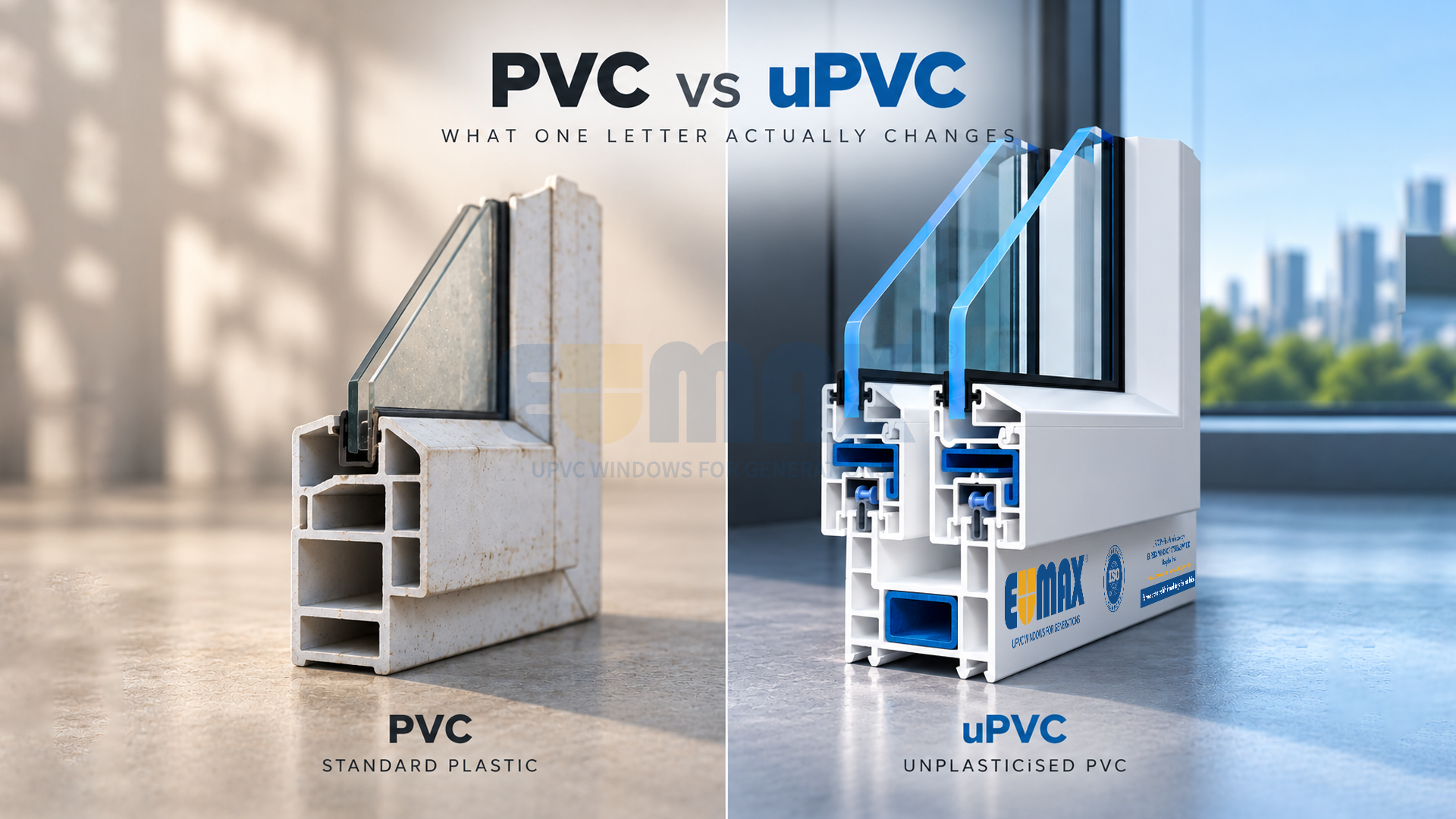
uPVC conducts heat poorly, and multi-chamber profiles improve on that further — each sealed air pocket interrupts the conduction path. In an air-conditioned room the frame stops being a bridge for heat, which is a continuous effect rather than an occasional one.
It seals
Profiles are designed around gasket systems, and corners are fusion welded rather than mechanically joined, so there is no fastening to loosen and open a gap. Good sealing is what determines noise, dust and cooling load, and it is the least visible thing a window does.
It ignores humidity
It does not absorb water, so it does not swell in the monsoon or shrink in the dry season. A window that closes properly in March closes properly in August. In a country with a defined wet season, this matters more than it sounds.
It does not corrode or rot
Salt air, sustained humidity and rain leave it chemically unaffected. Termites have nothing to feed on.
It stops asking for attention
No repainting, no anti-rust treatment, no pest treatment. Washing, occasional hardware lubrication, and clearing the drainage before the monsoon. That is the whole maintenance obligation.
Where uPVC is not the right answer
Stated plainly, because a fair case includes the exceptions.
Heritage and conservation buildings. Where a building's character or a planning requirement calls for timber, uPVC is not appropriate however well it performs.
Very large commercial spans. Beyond a certain opening width, aluminium's stiffness is genuinely the better engineering answer. uPVC can be pushed there with deeper sections and heavier reinforcement, but there is a point where it stops being sensible.
Where the slimmest possible sightlines are the priority. Aluminium achieves equivalent strength in a narrower section. If minimal visible framing is the governing requirement, that is a real advantage.
Where authentic timber grain matters at close range. Laminates are good and improving. They are not timber, and at arm's length in good light someone who cares will see the difference.
Where the frame will be damaged and need repair. Timber can be filled, sanded and refinished. A damaged uPVC section is replaced.
Questions that settle it
Is the building in a humid or monsoon-affected region?
Most of India is. Dimensional stability through the wet season is uPVC's clearest practical advantage over timber, and the annual swelling cycle is what eventually opens timber windows up.
Will anyone actually maintain them?
Timber works well when it is maintained on schedule. The realistic question is whether that will happen in year eight, and in year fifteen, and if the property changes hands.
Are the rooms air-conditioned?
If so, frame conductivity and air leakage are running costs rather than abstractions. This is where uPVC's advantage over untreated aluminium is largest.
Is the property near the coast?
Salt air attacks timber finishes, rusts steel and pits aluminium coatings. It leaves uPVC alone. The specification attention moves to hardware grade instead.
How large are the openings?
Standard residential sizes are comfortably within uPVC's capability with proper reinforcement. Very large spans are where the conversation changes.
What separates a good uPVC window from a poor one
Choosing the material is the easy part. Two uPVC windows at different prices can be genuinely different products, and the differences are invisible.
- Wall thickness of the main frame section — governs rigidity and screw retention.
- Chamber count — determines thermal performance and stiffness.
- Steel reinforcement in frames and sashes. The sash is where it is most often quietly omitted.
- Hardware grade — what decides whether the window still works properly in year fifteen.
- Weld quality at the corners — a poorly welded corner is a stress point.
- Installation — square, plumb, mechanically fixed and fully sealed. The best specification fitted badly performs like an ordinary one.
Buying from a manufacturer
Most window companies in India are fabricators who buy profiles from external suppliers. When a profile-level defect appears, the fabricator depends on that supplier to acknowledge and resolve it.
Eumax extrudes its own profiles at Nelamangala and supplies finished windows and doors across Bengaluru and surrounding areas, so the profile specification, the fabrication standard and the accountability sit with one company. For a buyer that is a practical difference rather than a marketing one — it removes the gap where responsibility gets negotiated.
The honest conclusion
uPVC suits most Indian residential projects better than the alternatives, for reasons specific to the climate rather than to fashion: it ignores humidity, does not corrode, insulates without additional treatment, and asks almost nothing of its owner.
It is not the right answer everywhere, and a supplier telling you it is has stopped being useful. Where it is right, the decision that actually matters is which uPVC — and that comes down to the six specifications above.
Frequently asked questions
When is uPVC not the right window material?
Five situations: heritage and conservation buildings where timber is required, very large commercial spans where aluminium's stiffness is the better engineering answer, projects where the slimmest possible sightlines govern, cases where authentic timber grain matters at close range, and situations where a damaged frame will need repairing rather than replacing.
What separates a good uPVC window from a cheap one?
Six things, none of them visible on an assembled window: wall thickness of the main frame section, chamber count, steel reinforcement in both frames and sashes, hardware grade, weld quality at the corners, and installation. Two uPVC windows at different prices can be genuinely different products.
Is it better to buy from a manufacturer or a fabricator?
Most window companies in India are fabricators who buy profiles from external suppliers, so when a profile-level defect appears the fabricator depends on that supplier to acknowledge and resolve it. Buying from a company that extrudes its own profiles removes the gap where responsibility gets negotiated between parties.
Want a quote for your own openings?
Our team covers Bengaluru and surrounding areas.