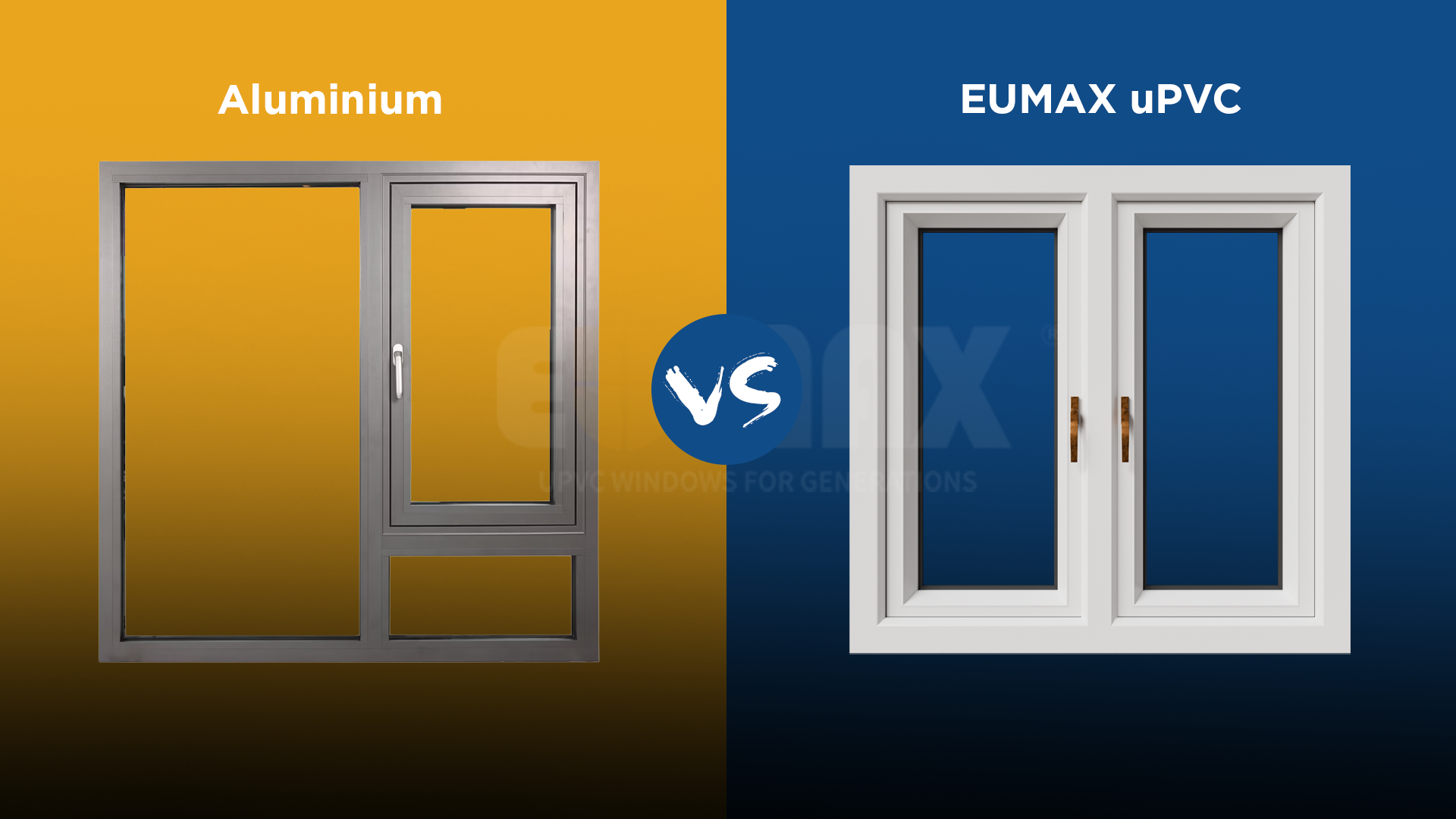
Aluminium and uPVC are the two materials most Indian window projects actually choose between. The comparison turns on one property above all others — how readily each conducts heat — and on what it costs to fix that in aluminium.
The conductivity problem
Aluminium conducts heat exceptionally well. That is why it is used for cookware and heat sinks, and it is precisely the wrong property for a window frame.
An untreated aluminium frame in afternoon sun becomes hot to the touch and carries that heat directly through the wall into the room. It is a thermal bridge — a path that bypasses whatever the glass is doing.
uPVC conducts heat poorly. The frame does not become a bridge, and multi-chamber construction improves it further: each sealed air pocket interrupts the conduction path.
In an air-conditioned room this is a continuous, measurable difference rather than a theoretical one.
Thermal breaks, and what they cost
The aluminium industry's answer is the thermal break — a polymer insert running through the frame section, separating the outer face from the inner one and interrupting the conduction path.
It works. Thermally broken aluminium performs far better than untreated aluminium and can approach uPVC.
The catch is cost. Thermal breaking adds significantly to the price, typically enough to put a properly broken aluminium system at or above equivalent uPVC.
Which produces the trap most buyers fall into: a quote for untreated aluminium looks cheaper than uPVC, but it is not the same product. Compare thermally broken aluminium against uPVC and the price advantage largely disappears.
Corner joints
A less discussed difference with long-term consequences.
uPVC frame corners are fusion welded — heated and fused so the joint becomes continuous with the sections either side. There is no fastening to loosen.
Aluminium corners are mechanically joined, typically with corner cleats and crimping. It is a sound method, but a mechanical joint under repeated thermal cycling can loosen slightly over years, and a small gap at a corner is exactly where air and water find their way in.
Corrosion
Aluminium forms a protective oxide layer, which handles ordinary conditions well. In coastal air, salt attacks that layer and causes pitting — small surface craters that spread.
Anodising and powder coating improve resistance considerably. Both are surface treatments, so any scratch penetrating the coating gives corrosion a starting point.
uPVC does not corrode at all. Near the coast this is a substantial practical advantage, and it is why coastal specification for uPVC concerns the hardware rather than the frame.
Where aluminium is genuinely better
Two situations, and they are real.
Very large spans. Aluminium is stiffer than uPVC. Beyond a certain opening width, an aluminium section holds its geometry where uPVC would need considerable additional depth and reinforcement. For large commercial glazing this can be decisive.
Slim sightlines. Because aluminium is stiffer, it achieves the same structural performance in a narrower section. Where minimal visible framing is the priority, aluminium does it more easily.
Side by side
| Property | uPVC | Aluminium |
|---|---|---|
| Thermal conductivity | Low — insulates | High — needs a thermal break |
| Corner joints | Fusion welded, continuous | Mechanical, can loosen over time |
| Corrosion | None | Pits in coastal air without treatment |
| Span capability | Good with reinforcement | Better — stiffer material |
| Sightlines | Wider sections needed | Slimmer for the same strength |
| Maintenance | Washing | Washing; coating repair if damaged |
| Recyclability | Reprocessable; collection still developing in India | Well established |
| Colour | Laminated, bonded before fabrication | Anodised or powder coated |
How to compare a quote fairly
The single most useful question: is the aluminium thermally broken?
If not, the two quotes are not comparable — one is a window designed to insulate and the other is not, whatever the glass specification says.
Other things to establish:
- Is the aluminium anodised or powder coated, and to what grade — particularly near the coast?
- What glass is assumed in each quote?
- How are corners joined, and what is the warranty position if a joint opens?
- For uPVC, what is the wall thickness and is reinforcement in frames and sashes?
The practical answer
For standard residential openings in India, uPVC is generally the better choice: better thermal performance without additional treatment, welded corners, no corrosion, and no meaningful span disadvantage at domestic sizes.
Aluminium earns its place on very large spans and where slim sightlines matter more than conductivity — and when it is specified, it should be thermally broken, or the saving is being taken out of the building's performance.
Frequently asked questions
Are uPVC or aluminium windows better?
For standard residential openings in India, uPVC generally — it conducts far less heat without needing additional treatment, its corners are fusion welded rather than mechanically joined, and it does not corrode. Aluminium is genuinely better for very large spans, where its stiffness matters more than its conductivity, and where the slimmest possible sightlines are the priority.
Why are aluminium windows cheaper than uPVC?
Untreated aluminium usually is, but it is not the same product. Aluminium conducts heat readily, so an untreated frame acts as a thermal bridge into the room. Fixing that requires a thermal break — a polymer insert running through the section — which adds enough cost to put properly broken aluminium at or above equivalent uPVC. Compare like with like before comparing price.
Do aluminium windows corrode near the sea?
Aluminium forms a protective oxide layer, but salt attacks it and causes pitting — small surface craters that spread. Anodising and powder coating improve resistance considerably, though both are surface treatments, so any scratch that penetrates gives corrosion a starting point. uPVC does not corrode at all, which is why coastal specification for uPVC concerns the hardware rather than the frame.
Want a quote for your own openings?
Our team covers Bengaluru and surrounding areas.